Tuesday, May 29, 2018

Super impact wrench

* My two most recent shade-tree projects presented me with a 27-mm harmonic-balance bolt and a 36-mm wheel-axle nut that wouldn’t respond to an impact wrench.  I managed to remove the harmonic-balance bolt with a 1/2"-drive breakdown socket wrench pulled at the 20" handle by a ratchet strap.  I managed to remove the wheel nut by use of  a large pipe wrench on a socket, the wrench's handle being extended by a 6-foot pipe (the breakdown wrench had snapped in an earlier attempt).
* All the while I was imagining and wishing for a new kind of impact wrench designed as shown in the following figures.
  *  The prospective device has two main parts: 1) a notched disk-shaped hammer component (diam ~ 8" - 10") cut from ~5/8" steel plate which spins on an axis counter-clockwise powered by an electric drill in reverse.
and 2) a wrench component cut from ~1/4" steel plate which transferes momentum from the hammer to a socket, via a square socket-drive bar (1/2" or 3/4") fused to a square hole at the wrench's axis.  The socket-drive bar extends through the wrench an inch on the opposite side, where it is rounded to a cylinder constituting the axis for the hammer to spin on.  The tip of this axis has a transverse hole with a pin to hold the hammer component (covered by a safety shield) flush against the wrench component.
The wrench component bears a spring-loaded catch which upon removal of a catch-retaining pin can jump into the path of the hammer's impact notch to receive the built-up angular momentum.  The wrench component's distal end is equipped with an eye to which a nylon rope is tied connecting it to a nearby stable object (eg car frame or suspension) to brake the excess angular momentum, so the device doesn't become a wild "battlebot" amputating the worker's extremities after loosening the nut or bolt.
The device is equipped with a safety shield covering the hammer to protect fingers from shearing between the hammer impact notch and the catch.  Its edge is rounded or beaded to avoid cuts.


Sunday, April 22, 2018

Lessons from radio waves

* As a recreationist contemplating forces of nature, I have believed that electromagnetic fields and waves summate but do not interact among themselves, that they do interact with particles which produce, absorb, reflect, refract and diffract EM fields and/or waves.  I wonder whether that belief agrees with serious theory.
* Consistent with my belief, waves pass through fields emerging intact, opposing waves pass through each other and proceed unaffected (as in standing waves), and neighboring waves interfere constructively, a summative relation not an interactive one.  But it's hard to reconcile this belief with my belief about radio waves.
* Specifically, I believe that each phase of a radio wave is a shower of short (perhaps IR-length) photons of phase-specific spin.  The EM energy doesn’t come from the transmitter antenna as a whole, it comes from charged-particles accelerated where the EMF pulse is progressing along the antenna.  EM energy coming from an electron near one end early in a phase should not know that it is associated with EM energy coming from an electron near the other end later in that phase.
* Giving me pause is the fact that radio waves bend around obstructions, diffract in grids, filter on macroscopic polarizers and penetrate walls as if they were very long unitary photons rather than showers of much shorter like-spinning photons.  Perhaps photons contributing to a larger wave somehow interact with structures as if they were integral to the wave, implying communication across the wave (in space and time) that I wouldn’t anticipate.
*  This might be analogous to the behavior of particles in the double-slit experiment, exhibiting statistics as if responding to distant untouched structures. Attempts to reconcile the double-slit results became foundational to quantum mechanics theory.  Perhaps something enlightening will derive from attempts to reconcile particulate, spatially-separated and temporally-separated photon emission with unitary radio-wave action.  This would imply interaction among photons within a shower of photons, contrary to my beliefs expressed at the outset.

Sunday, March 4, 2018

Semi-truck anti-jack-knife proposal

  * Considering a semi truck’s design, one can predict that it will jack-knife with little provocation – a modest left-right imbalance of braking traction or forceful braking during an avoidance turn.  After witnessing a jack-knifing incident up close, metal fragments dropping in my path, I have been imagining how such events can be prevented.  During a jack-knifing, the tractor points so much left or right, that steering is impossible.  Needed is a means to point the tractor in the direction of its motion, so the driver can steer it.
  *  I began by considering the range of tractor-to-trailer angles and front-wheel steering angles under common conditions.
  * Fig. 1 shows the angles during constant left turn.  The outer circle is the path taken by the tractor’s front mid-axle, the slightly smaller circle is the path taken by the tractor’s rear mid-axle, the inner circle is the path taken by the trailer’s rear mid-axle after it moves elliptically to its steady-state position.  In this illustration, the trailer’s axle-axle length (2 to 3) is thrice the tractor’s axle-axle length (1 to 2).  Once a steady state is established, a modest front-wheel pitch (1 in 3) will result in a substantial tractor-to-trailer pitch (~ 4 in 3).  
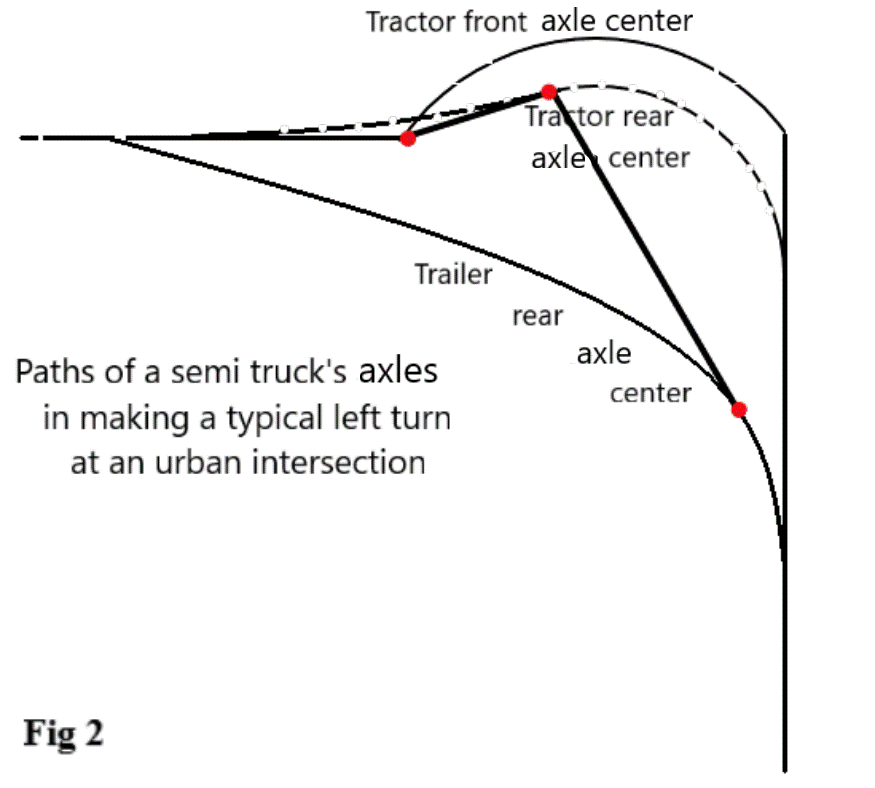
These paths might be followed during a U turn in a large lot, but typically the driver would cease turning before a steady state is established as illustrated in Fig 2, where the turn ends with a brief turn of the steering wheel in the opposite direction.
  * Here the driver takes the tractor on a wide sweep.  Approaching the side street, he/she will swing as far rightward as permitted, so the trailer’s rear wheels can best avoid a car in the left street’s oncoming lane.  For the same reason, he/she will pull as far beyond the intersection as permitted.  Early in the turn and until the tractor is in the side street, the tractor-to-trailer angel may be 90deg or slightly sharper.  Once the tractor's front wheels are in the eventual path, they will be steered rightward until the tractor's rear wheels are tracking in line.
  * Thus the relation between tractor front-wheel steering angle and tractor-to-trailer angle varies greatly during normal operation.  An algorithm and mechanism to prevent jack-knifing must freely allow those angles but quickly stop an increase of a tractor-to-trailer angle contrary to steering direction and/or it must rapidly halt and diminish a tractor-to-trailer jack-knifing angle.  A leftward jack-knife would be recognized as leftward tractor-to-trailer angle associated either with rightward drift of the tractor's rear wheels and/or with righward steering of the front wheels while skidding.  These conditions could be recognized by an optical device (analogous to an optical computer mouse) interacting with the road below the tractor's rear axle, perhaps aided by an accelerometer at this location.
  *  Figs 3 - 5 show a mechanisms to bring about the tractor-to-trailer angle responses.  
  *  In Figs 3 & 4, the mechanism consists of a servo-motor-driven spool (red) attached to the tractor's frame behind or below the cab, this connected by a cable or chain (green) to a large grooved hoop (red) attached to the trailer's frame concentric with the hitch.
  *  In Fig 3 the cable or chain crosses between the spool and grooved hoop.  The cable or chain wraps several times around the spool and is attached at its mid point.
  *  In Fig 4 a chain spans from spool to hoop on either side.  It doesn't wind on the spool, but engages a sprocket on the spool like a bicycle chain.
  *  In Fig 5, a servo-driven cog-wheel engages a larger ring attached reversibly to the trailer.

With sufficient strength of the elements, such a device should be able to halt and diminish a dangerous tractor-to-trailer angle move the angle toward optimal.


Tuesday, February 20, 2018

Challenge for Steve Mould

Steve,
  *  Here is a challenge for you that might have profound scientific interest.
  *  Make a hollow uniformly thick sphere of flexible and resilient material, possibly rubber or plastic, this coated or impregnated with a material that changes color with stretch.  It should have much more inertia than adjacent air so waves would propagate tangentially rather than radially.
  *  With that you should be able to visualize nodes and antinodes of spherical standing waves as you oscillate a small area with focussed sound waves of various pitches.
  *  The dynamics of your sphere should be those of a spherical bell.  You might be the first to observe such dynamics, possibly amazing shapes of overtones.
  *  It seems interesting to speculate whether energies of any electron in any atom might be overtones in spherical electron clouds.
  *  Let me know your thoughts on the spherical bell, if any.
David Regen, xmsdavidr@gmail.com

Tuesday, January 9, 2018

High-School Science Project

Function of radio-transmitter antenna
The goal is to test the hypothesis that a radio wave is not a unitary electromagnetic wave but instead is a shower of modest-length photons radiating from emf waves (front and back of voltage wave) as they propagate between ends of the antenna.
Studies on loop conductor
 * Using two(or more)-channel oscilloscope with signal generator and nanosecond time resolution, determine time for voltage pulse (leading edge of square wave) to reach points at various distances from positive input.  This can be done with test probes clamped to well separated uninsulated points on a loop conductor (wire forming a complete circuit from source to ground).
 * If oscilloscope cannot resolve this time difference, use longer wire between test probes.
 * If oscilloscope still can’t resolve this time, wind the wire as a spiral coil on a wooden dowel to increase inductance.  Increase number of coil loops to slow voltage pulse enough for time-course resolution.
 * If oscilloscope still can’t resolve this time, replace dowel with steel rod, perhaps a coat-hanger.
 * Using a sufficiently slow conductor, straighten two well separated 4-inch segments.  These will be test segments.
 * To each oscilloscope-channel’s probes, connect a wire loop with a 4-inch straight mid segment, each straight segment being a radiation probe.
 * Place radiation probes close to and parallel to test segments and tune channels to optimize screen display of signals.
 * Record probe signal intensities and emf directions with various probe locations, probe orientations, and objects (including polarizing filters) between test segments and probes.
 * Record probe signal shape with longer and longer voltage square-waves, noting signal decline during sustained voltage.
 * Repeat key measurements with entire loop-conductor shielded by cardboard layered with hardware cloth or aluminum screen (to block unintentional signals) with windows above test segments for intentional signal transfer.  Might be little different.
 * These studies should demonstrate that a voltage change moves as wave front from a source to the conductor's far end, that radiation occurs from any segment only as the voltage front and rear pass, that the radiation is polarized and bears information as to direction and valence of the passing voltage-change wave.
Studies on open circuit ie broken conductor
 * Cut the loop conductor at the midpoint and lay out the halves at some distance from each other.  Repeat key measurements.
Wave reflections of opposite emf valence may be observed.  Wave reflection is a feature of transmitter antennas.  By adjusting frequency, it may be possible to achieve a standing wave, best demonstrated with four evenly spaced radiation probes.
Studies on dipole transmitter antenna
 * Form the two conductor segments into a dipole antenna: conductors adjacent over the first few inches near to signal generator, then turning 90 degrees in opposite directions.  Repeat key measurements.
Wires in dipole-antenna configuration should behave the same as the wires layed out randomly, as regards what happens at various locations and times.
Characterize determinants of transmission efficiency
 * Look at signal picked up by a receiver antenna at various distances and orientations and with various objects in the way.
 * Adjust generator wave form and frequency to establish a standing wave.  Observe strength of signal in receiver antenna as standing wave is achieved.
Mapping wave source vs time
 * Shield transmitter antenna to allow radiation only from selected segments, to characterize sources of radiation at various moments after pulse initiation.  One should see that the signal leaves the transmitter antenna when and where the voltage-change wave is passing.  Parts of the transmitter antenna where and when the voltage-change front is not passing do not participate in radiation to the receiver antenna.  This will require careful time accounting.
Possible findings
 * The above studies might disclose interesting features of electromagnetic radiation and magnetism.
 * It may be possible to demonstrate that the significant radio signal is from the emf pulse during its propagation, not from voltage oscillations, this contary to numerous accounts of transmitter-antenna function.
 * One might get evidence that the significant radiation is of modest wave length (eg infra-red) not the length of radio waves, ie a radio wave is not a photon or unitary electromagnetic wave; it is a shower of modest-length photons (possibly IR) alternating in abundance and spin orientation during each cycle, contrary to some definitions of electromagnetic spectrum and photons.
 * Finally, explanations and accounts of magnetic force are mind-boggling.  Antenna radiation is kin to or the same as or easily confused with establishing and collapsing magnetic fields.  Observing these phenomena and contemplating them might evoke a valuable new insight into the nature of magnetism and radiation.
   Antenna mechanism        Photon model 

Wednesday, December 20, 2017

Country Pathos , Country Soul


Country parables         David M Regen © 1995

Old-time country music, it stirs my heart and soul
It draws me in its circle, my name is on its roll
Its prophets are compelling, its parables profound
So won't you come and join me, in this church of rustic sound

Luke the drifter talked to us, of things we need to know
Think my friend consider well, before a stone you throw
Watch your tongue lift up your thoughts, and gossip don't repeat
For you may be indebted to, the bad girl down the street

Acuff told a story, of one who had succumbed
Life for her was bitter, and from the bridge she jumped
They pulled her from the river, but no one knew her name
This woman had no loved ones, her body was unclaimed

I won't forget Red Foley, my heart-strings he did tug
He told us of the love that is, between a boy and dog
Shep pulled him from the swimming hole, where he had nearly drowned
When Shep was old it broke his heart, to put his dear friend down

These words of Eddie Arnold, I heard them long ago
Do not neglect your mother, the one who loves you so
She nurtured you and guided you, so do not leave her there
All alone an angel in an, old rocking chair

And give my love to Dolly, the brightest of the lot
Her mother made a coat of rags, when she was just a tot
The children all made fun of her, they did not understand
That love went into every stitch, by her dear mother's hand

Yes country can enlighten, wake up your sleeping soul
Turn you from your selfish ways, make kindness  your goal
This world would be a better place, a kinder place I know
With more old-time country music, on the radio


Click here for a page-ordered list of titles with YouTube links.


Indexed Titles               Page

Bereavement of parent
Dear brother  26
Every bush and tree  34
I miss Mother since she's gone  58
If I could hear my mother pray again      59
Letter edged in black  68
Lightening Express  69
Mother queen of my heart  82
Memories of Mother  83
Mother’s Bible  84
Mother's only sleeping  85
Newmade grave upon the green hillside          90
Summer wind         133
Sweeter than the flower         134
Unfinished rug         148
Vision of Mother 151
White dove 158
Will the circle be unbroken 161
Bereavement of child
At the first fall of snow     5
Don't make me go to bed    28
I hear a sweet voice calling        56
Searching for a soldier’s grave    122
Strand of a yellow curl  132
Teardrops falling in the snow      137
The vacant chair  150
Bereavement of contemporary
Bathe me in lilac       7
Bluebird sings for me      15
The day they laid Mary away          25
Dear Uncle Sam      27
Flower blooming in the wildwood          39
Footprints in the snow      40
I haven’t seen Mary for years      55
In the baggage coach ahead      62
Listen to the mockingbird      70
Lonely mound of clay       71
Maple on the hill       74
Mighty dark to travel       78
Old Shep       97
On the evening train       99
Precious jewel      107
Roses in the snow      116
Silent empty chair      125
Weathered gray stone      154
Will the roses bloom where she lies slpn       162
You’ll find her name written there      166
Calamity
Amelia Earhart’s last flight           2
BJ the DJ   6
The blizzard  12
Daddy don’t go to the mine  23
Drowned in the deep blue sea  30
Engine 143   33
Five miles from home   38
Muddy water    87
Sign on the highway  124
Sinking of the Titanic  127
Train 1262  145
Wreck of old 97 164
Wreck on the highway 165
Cruelty / Neglect
Coat of many colors    19
Give me the roses    44
If Jack were only here    60
No children allowed    92
Nobody’s child    94
Orphan girl 101
Over the hill to the poorhouse 102
Rocking alone 115
Row us over the tide 119
Ruby don’t take your love to town 120
Thirty pieces of silver 141
Tramp on the street 146
Unloved and unclaimed 149
Walking my Lord up Calvary hill  152
Down & Out / Adversity
Hard times come again no more    47
Hard times have been here    48
Lost highway    73
Men with broken hearts    77
More to be pitied    81
Muddy water    87
Pictures from life's other side 105
Ruby don’t take your love to town 120
Dying
Bathe me in lilac      7
Beyond the sunset      9
Cowboy's lament    22
Darling little Joe    24
The dying soldier    31
Farside banks of Jordan    36
Green green grass of home    46
Just before the battle mother    64
Master's bouquet    76
My brother’s will    88
Nobody's darling but mine    95
Plant some flowers by my graveside 106
Put my little shoes away  110
Road trip 113
Rosewood casket 117
Soldier’s last letter 130
When God comes to gather his jewels 155
When I ride that last mile 156
Who will sing for me 159
Will my soul pass through the southland  160
Will you miss me 163
Loneliness
All smiles tonight       1
Blue eyes crying in the rain      13
Calling my children home      18
Golden ring      45
He stopped loving her today      49
Lonesome river      72
Missing in action         79
Rocking alone    115
Ruby don’t take your love to town    120
So lonesome I could cry    129
Tiny broken heart    142
Too late to cry     143
Tragic romance     144
Wandering boy     153
Nobility / Redemption / Innocence
Amen corner          3
Angels rejoiced          4
Be careful of stones you throw  8
Big bad John         10
The blind girl’s prayer         11
Coat of many colors 19
Darling little Joe 24
Eastbound train         32
Fallen leaves         35
The funeral 41
Give me the roses 44
Hickory holler’s tramp 51
His fields are ready for harvest 53
I heard my mother call my name in prayer 57
If Jack were only here 60
In the baggage coach ahead 62
Jimmy Brown  63
Legend of the robin’s red breast  67
Lightening express  69
Missing in action  79
Mother queen of my heart  82

Sunday, October 15, 2017

Two tools that ought to be

This week I worked most of three days trying to remove air-conditioner components from my 1996 Mercury Villager minivan -- and wishing for two tools that might be handy in a car repair shop.

  1)  Fixed wrench lever.   To turn a stuck nut or bolt crowded by neighboring structures.  The tool would hold a small eye wrench or C wrench firmly at any desired angle and provide mechanical advantage.

  2)  Shear on a stick.  To cut hoses crowded by neighboring structures.  This would have a hook and blade like a rose clipper at the end of a shaft, the blade forced into the hook by sliding motion rather than scissor motion.  The forcing of blade into hook would come from repeated gripping of a handle at the opposite end.